
What Artificial Intelligence Really Is
Artificial intelligence, conventional software, automation, algorithms, models, narrow AI, artificial general intelligence and the historical development of the field.
Since 1997 • Online • Distance Learning • Global
Artificial Intelligence AI-101
A Non-Technical Introduction to Modern Artificial Intelligence
Build a clear and practical understanding of how modern artificial intelligence works without programming, advanced mathematics or prior technical training.
AI-101
Artificial Intelligence Foundations is a structured beginner-level course for learners who want to understand artificial intelligence beyond headlines, product demonstrations and technical jargon.
The course explains how data, machine learning, neural networks, generative AI, computer vision, audio systems, robotics and autonomous systems fit together. Students also examine the limitations of AI and the importance of privacy, security, fairness, verification and meaningful human oversight.
The program is designed for intelligent adult learners and does not require programming experience, advanced mathematics or previous study in computer science.
Learning objectives
Explain how artificial intelligence differs from conventional software, automation and rule-based systems.
Describe how datasets, training, validation, testing and inference support AI development.
Distinguish supervised, unsupervised and reinforcement learning.
Explain neural networks, deep learning and transformers at a conceptual level.
Describe how generative AI and large language models produce content.
Recognize common problems including hallucination, overfitting, bias, data leakage and distribution shift.
Understand the foundations of computer vision, audio AI, robotics and autonomous systems.
Evaluate an AI system by examining its purpose, data, method, output, risks and human oversight.
Discuss privacy, security, fairness, transparency and accountability in responsible AI use.
Identify pathways for continued AI learning and professional development.
Ten structured modules
Artificial intelligence, conventional software, automation, algorithms, models, narrow AI, artificial general intelligence and the historical development of the field.
Structured and unstructured data, collection, labeling, quality, representativeness, privacy, bias and the complete data lifecycle.
Supervised, unsupervised and reinforcement learning, model evaluation, generalization, overfitting and practical error analysis.
Layers, weights, representations, convolutional networks, recurrent networks, transformers and the strengths and limitations of deep learning.
Language models, tokens, context, prompting, generation, hallucinations, verification, retrieval and introductory AI-agent concepts.
Image recognition, object detection, speech systems, synthetic media, multimodal analysis, authenticity and consent.
Sensors, perception, planning, control, actuators, autonomy, safety boundaries and human intervention.
AI applications in healthcare, finance, education, retail, logistics, manufacturing, government, agriculture and small business.
Ethics, privacy, security, bias, fairness, explainability, accountability, governance and meaningful human oversight.
AI agents, multimodal systems, emerging applications, professional roles, transferable human skills and lifelong learning.
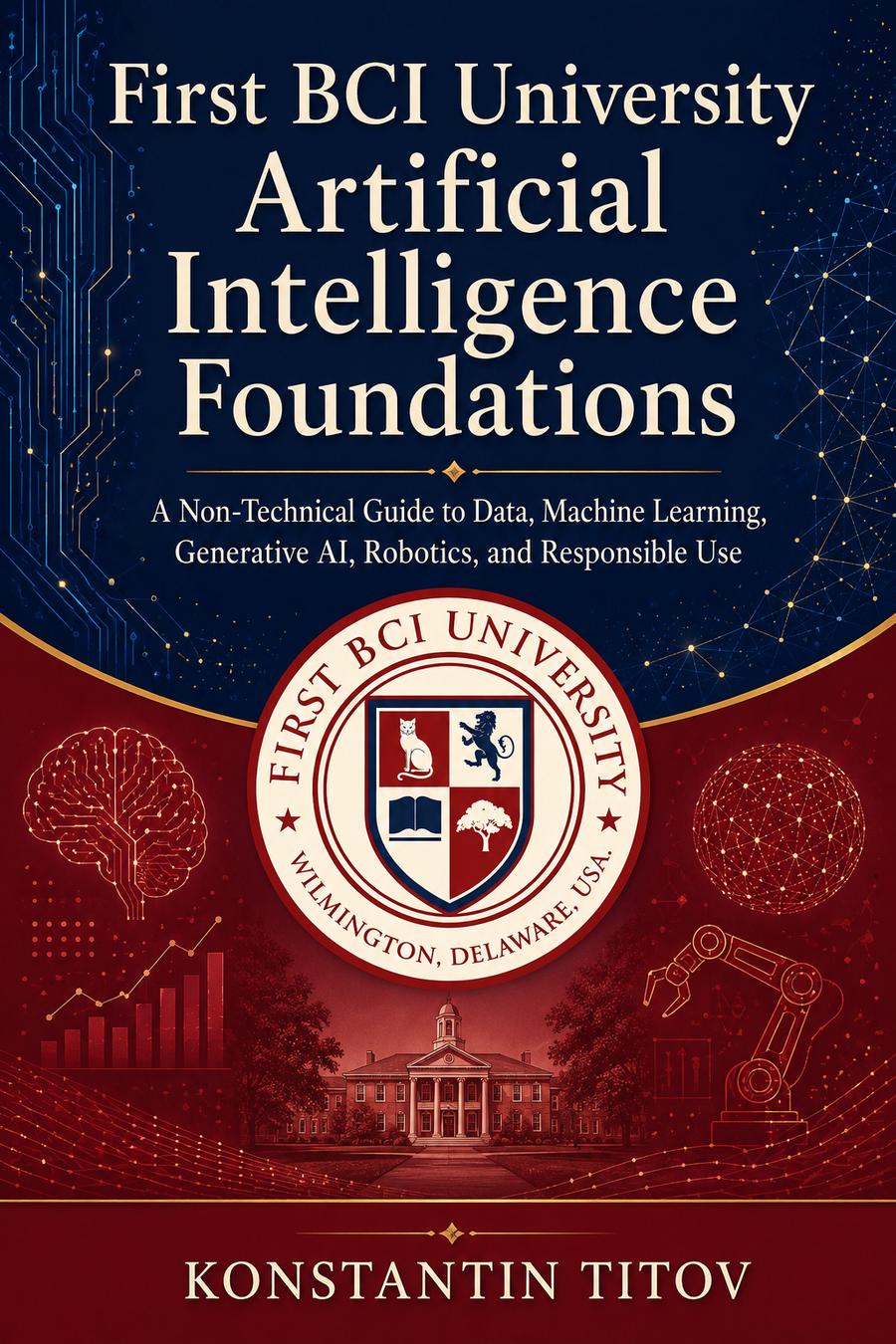
Official recommended coursebook
This book is the recommended learning material for AI-101. Its ten chapters follow the course curriculum and provide detailed explanations, realistic scenarios, knowledge checks and applied learning activities.
Available as a secure downloadable eBook for US$12.99.
BUY THIS BOOK — US$12.99Successful completion
AI-101 Enrollment
Purchase secure online access to AI-101. The electronic First BCI University Certificate of Completion in PDF format is included after meeting the completion requirements.
BUY THE COURSE NOW